Wednesday, 17 August 2022

The oldest type of potsherds in Finland! Excavating the Ruskiasuo Early Comb Ceramic Culture dwelling site.

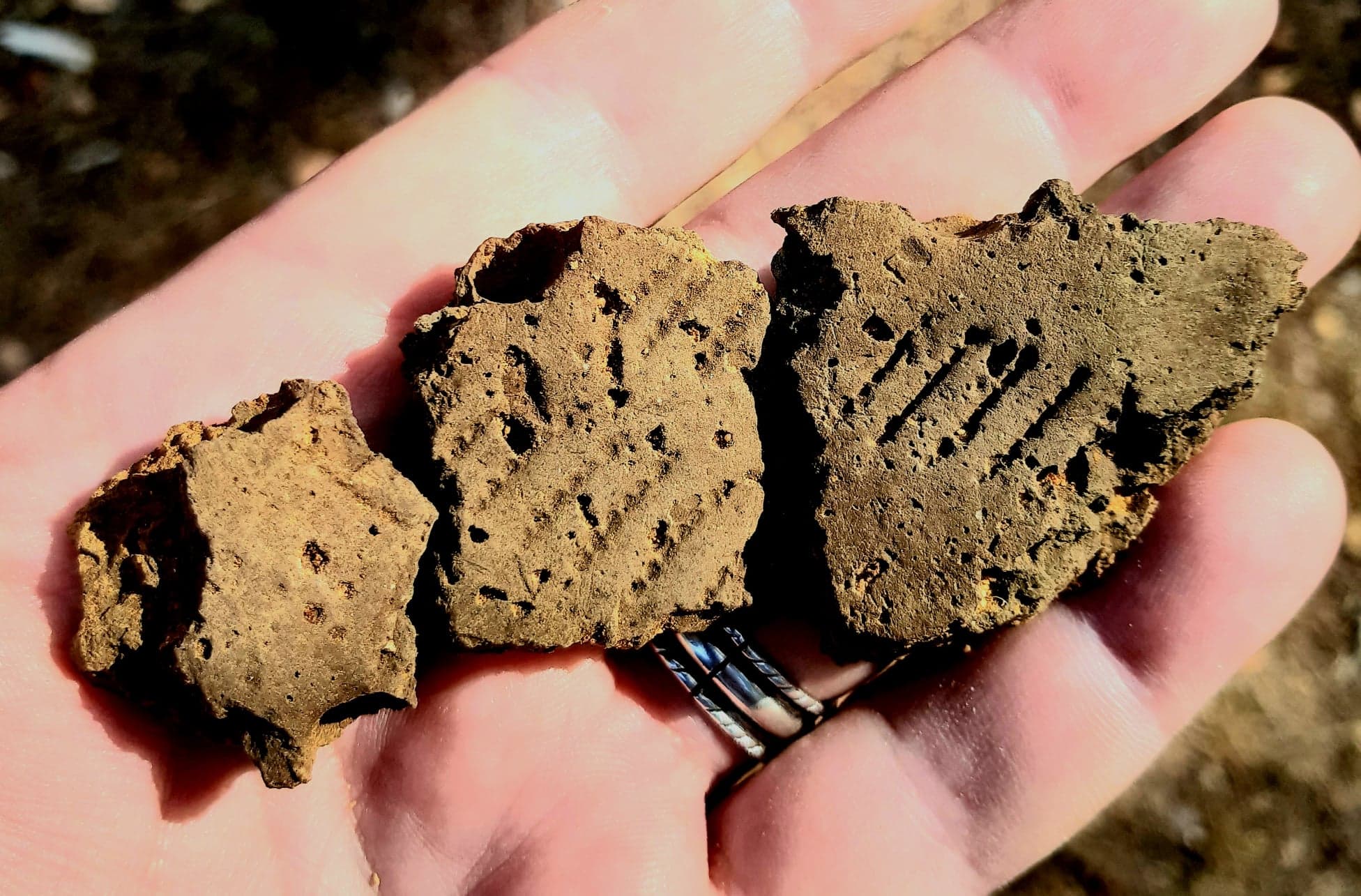
Personally I find nothing more intriguing than the oldest pottery in Finland. The dear potsherds have many names. Over the years it has been called Sperrings pottery, Early Comb Ceramic pottery and/or simply Ka I:1. Radio carbon datings suggest that this kind of pottery was made around 5000-4500 BC. The Ruskiasuo site has been dated to 4900-4950 BC so we are very close to the beginnings of pottery making in the stone-age.


Early Comb Ceramic rim- and other potsherds found today on the Ruskiasuo site in Kouvola.

Todays work started with a lengthy drive from Helsinki to Kouvola. The area in the region close to the dwelling site is monotonous and very flat indeed. Traffic was nonexistent and I reached the excavation site just a few minutes after 10 a.m.

The road to the Ruskiasuo site.

As usual the first task today was to get rid of the topsoil. The weather was very hot but the crew managed to get the job done in a surprisingly short time!


The starting point. The excavation area before excavation and during the removal of the topsoil.

The first finds of small potsherds, quartz- and porfyrite flakes and burnt bone started appearing just 5 cm:s below ground surface. It´s perhaps needless to say this promises a couple of very exiting days when we reach the proper find layer some 10-15 cm:s down.


Focused participants during the first day of the 2022 dig.


Saturday, 13 August 2022

A unique beautiful curved flint artefact! Excavating a Late Comb Ceramic Culture dwelling site in Pitäjänmäki (Helsinki). Day 4/5

Today we started off as usual at 10 o´clock. After a short briefing about yesterdays finds and the general progress of the dig it was again time to get our hands dirty. 

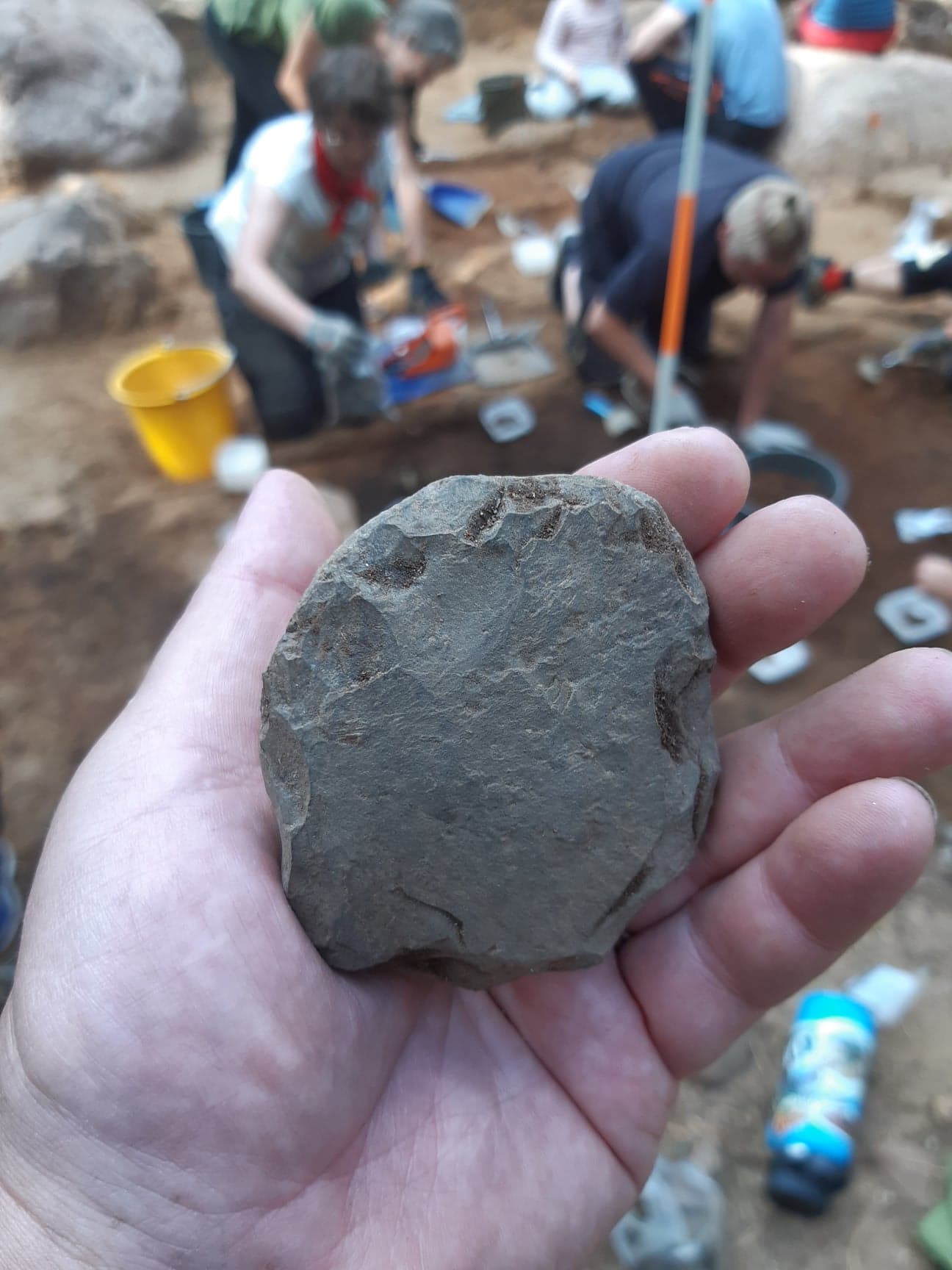
The assumption that the finds in the bottom part of the find layer might surprise us became true when a large, beautiful and complete flint artefact was found shortly before the day ended. The item resembles a so called curved slate knife which can be associated with the Typical Comb Ceramic Culture. Despite my over 30 years as a field archaeologista and conducting more than 200 excavations I have never encountered one that was made of flint before!

Curved flint knife from Pitäjänmäki Nuolipuisto.

The knife shows signs of wear on the convex edge while the concave edge is as sharp as it was knapped yesterday. It is not entirely clear what the curved knives were used for but skinning of animals is one possibility. Like so many items this one too might have been used for many different tasks.


Signs of wear and use on the convex edge of the flint knife.

The potsherds found today were larger than during the previous days and at least two concentrations of potsherds from three different vessels could be observed. 


Typical Comb Ceramic Culture potsherds

Tomorrow is the last day of this years excavation. Already at this stage I would like to thank all of the participants for making the week a very memorable one. A special thanks to archaeologist Indu Ramanayaka (Sri Lanka) and archaeology student Erik Djuvfelt (Umeå Universitet). It was a true pleasure to get to know you both. 

Flint knife and blue skies (possibly like 5 000 years ago)


Friday, 12 August 2022

Excavating a Late Comb Ceramic Culture dwelling site in Pitäjänmäki (Helsinki). Day 3/5

Today was the best day of the excavation so far with many Neolithic Stone-Age finds from the entire excavation area. No wonder we were all in a very happy mood and the six hours of work felt like two. Time sure flies when you´re having fun  :)


Excavation work in progress.

Todays finds included quite large amounts of Late Typical Comb Ceramic style (Ka II:2) potsherds belonging to several different clay vessels, burnt seal bones, fragments of charred hazlenut nutshells, burnt seal bones and a small piece of chewing resin.


A few late Typical Comb Ceramic Culture potsherds and a quartz core (bottom left) found today.

Todays finds also included a strange, small but intriguing burnt clay item. The find that resembles a button has wood impressions on the flat side. I have a faint memory that similar items were found on the Typical Comb Cermic dwelling site in Vantaa Jokiniemi site in the 1990´s.

Strange button shaped burnt clay artefact.

Tomorrow we will start excavating layer 3 which usually contains one or more nice surprises :) . Remember to check in here for more updates!

Participants in the Archaeology Field School checking the depth of the excavation area.


Thursday, 11 August 2022

Amber, pottery and much more! Excavating a Late Comb Ceramic Culture dwelling site in Pitäjänmäki (Helsinki). Day 2/5

The participants of the field school come from a wide variation of different backgrounds and also different nationalities like Great Britain, Sweden and Sri Lanka. We are of course grateful to all of you who have shown interest in the dig


Indu, an archaeologist from Sri Lanka and Erik an archaeology student from Umeå Sweden (right) assist us  during this years excavation.

Our crew was very busy this morning and at around twelve o´clock today we reached the first level of the find layer.  I was very surprised how nicely everyone helped each other out to achieve this first important goal of the dig.

Busy people. Marjo mapping the area and participants of the field school excavating layer 1.

The excavation area was carefully cleaned and the profiles straightened before documenation. The first excavation level showed only very minor discolorisation of the soil due to  human activity in the neolithic.

The long and narrow excavation area photographed in layer one.

In the afternoon the finds started to mount up and every participant got their share of stone-age finds like neolithic pottery, quartz-, slate- and flint flakes. A large slate core beautiful Late Typical Comb Ceramic ware and some fragments of an amber pendant finished the day.


A slate core and Late Typical Comb Ceramic potsherds.


Wednesday, 10 August 2022

Excavating a Late Comb Ceramic Culture dwelling site in Pitäjänmäki (Helsinki). Day 1/5

After a couple of days rest it was time to grab the trovel again today and start excavating one of the last remaining neolithic stone age dwelling sites in Helsinki. The site is situated on the edge of a beautiful park area just some 8 km:s from the heart of the city.

The 5 500 year old dwelling site is located in the forest, near a well kept park. 

During the neolithic stone-age 5 500 years ago the seal hunting population of this site lived on a shallow sandy cape by the sea. Because of the land uplift the area is now situated some 23 m:s above present day sea level.
A seal made out of concrete welcomes vistors of the park.

As this was only the first day of the one week long excavation the main task today was only to locate the excavation area of 2004 and continue excavation from where we left off 18 years ago. This proved to be more difficult than expected and we were able to reach the uppermost part of the find layer much later in the day than anticipated.

The topsoil has been removed, time to start digging.

On the first day of the excavation we encountered small finds of potsherds, flint- and quartz flakes over the entire excavation area. This is a good sign which usually means more finds deeper down in the find layer. The coming days will show what this site is all about so thumbs up!


Thursday, 4 August 2022

Excavating a neolithic Pitted Ware Culture dwelling site in Geta. Day 9 /10

Ultimately every excavation has to end. Because of heavy rain tomorrow we finished the excavation of the beautiful neolithic stone-age dwelling site in Geta already today. A few very interesting spots were left to be excavated in 2023 but 90% of the excavated area is snow filled up and carefully restored to its pre-excavation state. The finds were plentiful until the last very last minutes of the dig.

Last minute finds, large neolithic potsherds from excavation layer 4.

Excavation of the bottom layer underneath the rectangular stone feature produced very large fragments of unburnt and burnt bone and some pottery and porfyrite flakes to adepth of around 50 cm:s below ground surface. A round piece of burnt clay was found close to the structure and some interesting porfyrite tools a bit futher away.

A round piece of burnt clay and porfyrite tool.

It´s always a bit sad when an excavation comes to an end. Luckily our team will meet up one last time tomorrow when we visit Ålands Museum to take look at the stone-age exhibitand discuss the excavation results and the continuation of the digs in Geta between 2023 and 2027.

The restored and filled up excavation area. Photo Tryggve Gestrin.