Sunday, 26 May 2019

Mapping the traces of the Battle of Bengtskär (26.7.1941)

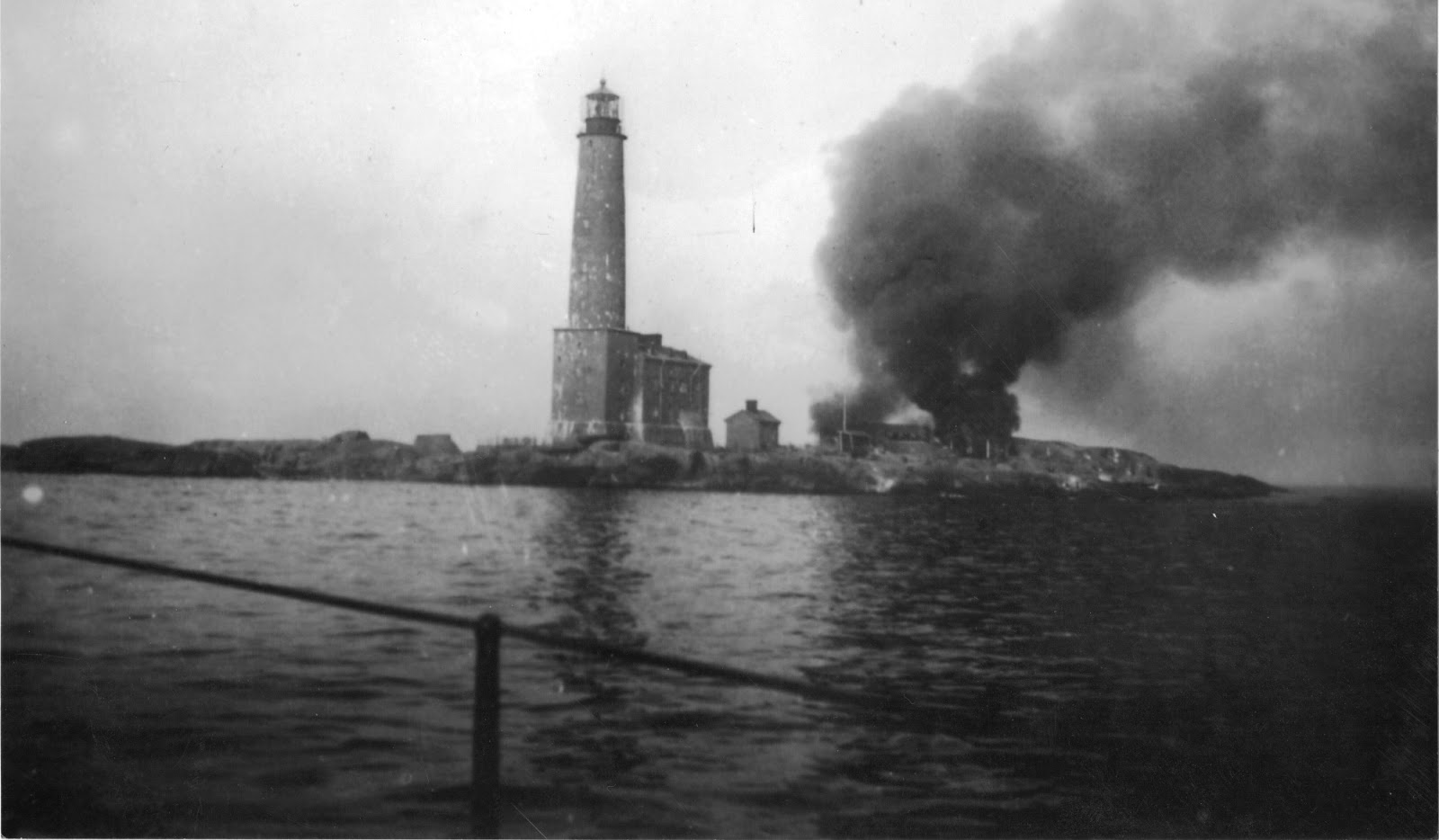
On the early morning of May 17th our WW2 conflict archaeology team drove to the boarder guard station at Cape Tulliniemi in Hanko. From there we were escorted, very professionally, to the island of Bengtskär, where we spent the whole day studying and mapping the traces of the fierce fighting that took place here in 1941.

Bengtskär lighthouse, seen from the direction of the soviet assault in the early hours of July 26th 1941.

GPS mapping.

The aim of the visit was to register all traces of battle no matter how large all small. The survey included GPS mapping of grenade impact traces as well as the registration of areas with finds from the battle.

Grenade impact trace in the bedrock near the lighthouse.

During the day we encountered several traces and even finds from the battle which were promptly registered in our database. Already at this early stage it is quite clear that the results of the survey propose a partially new hypothesis about the battle. The accurate 3D model of the battlegrounds are now well underway and will be displayed in an upcoming exhibition in Hanko and a forthcoming publication.

Preliminary map of the battleground by Aleksi Rikkinen and Teemu Väisänen. The dots mark traces of battle and different areas of future interest for our research

Thank You all who participated and especially Hangö Sommaruniversitet, The personnel at The Boarder Guard Station in Hanko and Paula Wilson at the Bengtskär lighthouse for taking such good care of us during our visit. And last but not least thank you all 400 nesting Eiders for "the look" :)


Saturday, 18 May 2019

On the road again 2019


After some really sinister WW2 conflict archaeology digs in May it´s finally time for the "2019 JFA Summer Tour".

We will be excavating on several different stone-age sites. I will post regular daily updates of our research and finds here so please stay tuned.

Jan and Janne

Thursday, 18 April 2019

Inför den kommande utgrävningen i Kouvola 6-10.6.2019 "I arkeologens fotspår - Jordgubbslådan"

Fyndplatsen för fynden i jordgubbslådan år 1988.

Jordgubbslådan

Året var 1988. Jag styrde Saaben i riktning mot Borgå. Bilstereon dunkade dovt på hög volym. Vi hade stämt träff vid busstationen i Elimäki.

-                           “Jag kommer med en stor Kawasaki motorcykel du hittar mig nog”, hade provgrävningsgruppens ledare Simo Vanhatalo sagt i telefonen.

Jag hade sett Simo på caféet på Museiverket, alltid skrattande och som det verkade alltid på gott humör. Han satt ofta med andra äldre studeranden från Helsingfors universitet. Måste vara en ganska tuff typ hade jag först tänkt och det här med att komma till utgrävningen på motorcykel gjorde inte precis bilden annorlunda.

I Elimäki centrum syntes nu ingen motorcykel, och inte heller någon busstation. Kommunens centrum verkade helt öde. Plötsligt var jag inte mer så säker på att jag var i centrum. Platsen såg helt för obetydlig ut. Jag började köra runt och kände nervositeten stiga. Jag borde förståss ha frågat Simo var busstationen fanns men jag ville ju inte göra bort mig med att fråga sådana  självklarheter, alla  riktiga arkeologer visste ju säkert var busstationen i Elimäki fanns… Jag förbannade min dumhet och svor högt för mig själv.

Efter något som säkert hos en polis skulle ha fort tankarna till ett kvartersrally (trots att det var tidig morgon) såg jag en man i läderoverall gå in i ett café. Jag stannade hastigt bilen och gick efter honom. Jo, det var Simo och jo, han hade väntat länge på mig. Inne på cafét luktade det tobaksrök och apatiska gubbansikten stirrade på oss. Dethär var Elimäki busstation.

-                           “Grävarna väntar, nu är det bråttom. Jag kör före kom du efter med din bil.”
Simos röst var vänlig men jag tyckte mig kunna ana allvaret bakom.

På parkeringsplatsen utanför kommunhuset stod ett gäng spinkiga ungdomar som vi snabbt hälsade på. En mycket blandad skara både till utsende och åldersfördelning, kunde jag konstatera.

Inne i kansliet var det svalt, rent och mycket tyst. Simo gick vant in och presenterade sig för personalen medan jag följde några steg efter. Kultursekreteraren, en kvinna i 30-års åldern tog emot oss i sitt sterila arbetsrum. Vi fick höra att grävarna var lokala unga arbetslösa och anställda med statligt sysselsättningsstöd. Hon berättade att lokaltidningens redaktör var på väg redan samma dag för att intervjua oss. Simo lyssnade på hennes allt ivrigare tal, men meddelade kort att någon intervju kommer inte på fråga förrän vi har något att berätta.

Snart körde vi iväg mot grävningsplatsen. Jag och Simo körde först i min bil och ungdomarna i sina egna bilar efter oss. Simo berättade om den kommande utgrävningen som skulle ta två veckor i anspråk. Uppdraget var klart avgränsat, vi skulle kontrollera om det fanns någonting kvar av en tidigkamkeramisk stenåldersboplats som nyligen berörts av sandtäkt.

Efter att ha väntat några år på tillstånd från Museiverket för att ta sand ur en sandgrop på sin mark hade denne slutligen tröttnat och tagit lagen i sina egna händer och grävt bort massor av sand från den fredade boplatsen. Stämningen mellan Museiverket, Elimäki kommun och markägaren var spänd och Simo var orolig. Markägaren hade hotats att ställas inför rätta. Lokalpressen gick het.

-                           “Han har sagt att han släpar ett ruttnande svinkadaver till sandgropen före grävningen börjar”, sade Simo.

Vägen blev allt smalare där vi susade fram genom stora vida sädesfält. Lukten av dynga från svinstior intill vägen fick mina ögon att rinna. Högt uppe över åkrarna slog tiotals svalor. Högsommarvärmen började kännas besvärande. Plötsligt svor Simo till. Jag försökte förstå varför, Simo pekade framåt. På några hundra meters avstånd gick en man långsamt över vägen precis där stenåldersboplatsen enligt kartan skulle ligga.

-                           “Markägaren”, utbrast Simo nervöst, “dethär kan bli jävligt tråkigt”.

Nu visste jag ju inget om såna här problematiska situationer sedan tidigare, så nervositeten började tränga fram och jag tänkte plötsligt på hur idiotiskt allt såg ut med vår karavan av dammiga bilar som rullade fram genom åkerlandskapet. Vi saktade in, men mannen försvann in i ett närbeläget hus utan att ta någon som helst notis av oss. Jag drog en suck av lättnad.

Vi stannade bilen vid en mycket brant sandgrop. På krönet och i sluttningen växte ståtlig tallskog. Ingen lukt av ruttnande svinkadaver tack och lov! Simo tände en Hofnar Lilliput och gick iväg för att kolla terrängen medan jag blev kvar och bekantade mig med grävarna. Om ca 10 minuter kom han tillbaka.

-                           “Här finns det ingenting kvar”, sade han och tände en ny Lilliput cigarill.

Jag vistte inte vad jag skulle svara. Hur i all världens dar kunde han på 10 minuter komma till ett sånt deprimerande slutresultat. Vi skulle ju gräva här i två veckor och vi hade inte ens satt spaden i jorden. Jag nickade men vågade inte fråga varför han tänkte som han gjorde. Simo gick till bilen och tog fram en portfölj som innehöll arbetsavtal och andra papper.

-                           “Du kan säkert det här med arbetsavtal, gör upp pappren med grävarna”.

Simo tog några linjekäppar och gick in i skogen. Jag satte igång med arbetsavtalen utan att ha en aning om vad det var jag gjorde, men att fylla i papper kunde väl inte vara så svårt? Jag såg snabbt på pappren och insåg att jag inte förstod just nånting av det som skulle fyllas i. Simo syntes inte till och framför mig hade jag grävarna.

Utan att avslöja någonting delade jag ut pappren åt ungdomarna och försåg dem med pennor. Till min stora förvåning började de vant fylla i blankett efter blankett. Efter en halv time samlade jag in pappren och lade dem i en bunt på bilens framsäte. “Mission accomplished”, det kändes fint att inte ha behövt bjuda på en andra besvikelse inom två timmar.

Under tiden hade Simo slagit upp linjekäppar här och var längs sandgropskanten. Käpparna markerade platser för provgropar av storleken 1x1 meter. Det var bara att dela ut spadarna och förrän jag anade det hade grävningen börjat.

Myggen var ettriga och bromsar och sega tallrötter gjorde snart slut på våra unga grävare. På eftermiddagen satt de flesta bara och petade apatiskt  i marken. Simo verkade ofattbart lugn inför det som i mina oerfarna ögon såg ut som en förestående katastrof.

Några små kvartsavslag hittade vi trots allt under de första fyra dagarna. De vita små vassa kvartsbitarna blev till formidabla skatter i grävarnas ögon.  Trots att vi  grävde upp en fyndlös provgrop efter en annan, började humöret stiga bland grävarna. Det oerfarna grävningsmanskapet hade börjat svetsas samman till en grupp, och en riktigt trevlig sådan.

På torsdag eftermiddag, efter att vi grävt tomt nästan hela veckan, hittade vi två små och mycket illa medfarna krukbitar från stenåldern. Bitarna var i alltför dåligt skick för att typbestämmas, men vi tippade på tidig kamkeramik på grund av den grova avmagringen i lergodset.

För våra grävare var fyndet av krukbitarna som att hitta guld. Alla ville plötsligt gräva närmare den grop där krukbitarna hittats och visst förstod man ju dem. Stämningen var i topp.

Plötsligt hördes ljudet av en bilmotor från sandgropens riktning. Jag gick till sandgropskanten och såg att en rostig vit paketbil parkerat bredvid våra bilar. Uppför sandgropskanten kom en man med Hankkijakeps på huvudet. Hans utseende förde tankarna till markägaren och svinkadavret så jag sprang snabbt till Simo och rapporterade.

-                           “Nu kommer han”, sade jag andfådd.
-                           “Perkele”, sade Simo.

Mannen klev med stadiga steg över stubbar och stenar i vår riktning. Han såg allvarlig, men i övrigts vänlig ut. Väl framme vid Simo tog han av sig kepsen och skakade hand och presenterade sig. Jag hörde namnet Erkki och förstod att det här inte var markägaren. Simo såg menande på mig och log. Faran var över. Simo plockade vant fram den lilla fyndpåsen med krukbitarna och förberedde sig att berätta om fynden, men kepsmannen hann först.

-                           “Jag hörde att det finns arkeologer här så jag tänkte komma och titta på. Jag har hittat nånting som kanske intresserar er.  Jag har dom i bilen” sade han.

-                           “Säkert”, svarade Simo och satte tillbaks fyndpåsen i plastämbaret.

Simo hade redan tidigare berättat att han var trött på att gå och se på allsköns naturstenar som ivriga människor hämtar till provgrävningar i tron att dessa är stenyxor. Nu kom hans svar blixtsnabbt.

-                           “Gå och titta du, jag har jätte mycket att göra och så måste jag fotografera ännu”, sa Simo och spelade stressad.

Det här var tydligt kodspråk för mig och jag gick glatt iväg med kepsmannen i riktning mot paketbilen. Jag kände mig ärad och allt annat än skeptisk.

-                           “Jag tror det är krukbitar”, sade mannen medan han med långa vana kliv rörde sig i skogen i riktning mot sandgropskanten.

Framme vid bilen väntade jag mig att han skulle öppna bildörren och ta fram någon påse med krukbitarna men till min stora förvåning slog mannen bilnycklarna i paketbilens stora gliddörr istället och ryckte till i handtaget. Med ett gnisslande och en duns gled den stora rostiga bildörren upp.

Inne bland spadar och andra redskap låg en låda som enligt texten på sidan innehöll jordgubbar från Suonenjoki. Jag fattade ingenting. Mannen ryckte ut jordgubbslådan och ställde den på marken. Han tog bort den smutsiga mattan som täckte innehållet. Det jag nu fick se var något totalt ofattbart för en ung arkeologiestuderande. Hela jordgubbslådan var full med stora ofantligt vackert ornerade tidigkamkeramiska krukbitar. På en del av bitarna syntes spår av rödockra.

-                           “Nåh vad tror du, är dethär nånting”, sade mannen.
-                           “Fantastiskt”, var det enda jag fick fram.

Ruskiasuo boplatsen hösten 2018.

Berättelsen får en fortsättning när vi inkommande sommar gräver ut platsen. Jag har väntat på denna utgrävning ända sedan 1988...

Sunday, 7 April 2019

Documenting the WW2 heritage in Hanko S. Finland

"HANKO 1941" is a WW2 conflict archaeology project started by me Mr. Lasse Nyman (SMY) and BA, archaeology student Teemu Väisänen in the spring of 2018. We work closely together with Hanko Museum (the town of Hanko), Hanko Front Museum, Hangö Sommaruniversitet and Metsähallitus.

The battle for the Bengtskär lighthouse  June 26th 1941. Photographic documentation of the traces of a fierce battle in the SW Finnish archipelago.

The project aims at looking at the battles and forgotten fates of Finnish, Scandinavian and Soviet forces, individual soldiers and civilans on both sides, caught in action on a secluded part of Hitlers "Nordfront" in the early stages of "Operation Barbarossa" when after the German and Finnish offensive bloody battles raged on the mainland and especially on the islands around Hanko June 25th and December 2nd 1941.

Soviet propaganda picture showing the defence of Hanko ("Gangut) in 1941. We look objectively beyond this picture as well as the general picture of the battles as seen from the Finnish side.

During the past two days we have surveyed the Soviet (1940-1941) fortifications on the south side of Cape Tulliniemi with remarkable results. Some 70+ battle and rear positions give new insights into the Soviet preparations for a possible German or Finnish attack.

Some 70 Soviet fortifications, all built between 1940 and 1941 protected the Hanko beachead.

The idea is to preserve areas of the conflict for future generations as a reminder of the futility of war as well as a nature reserve area. Cape Tulliniemi in particular.

 The southernmost point of Finland, Cape Tulliniemi in 2019 and 1942. Photo Jan Fast and SA-kuva.

Thursday, 28 March 2019

Looking for accomodation in Hanko during the conflict archaeology excavation July 1-19th ?

Accomodation in Hanko during the “Durchgangslager Hanko 1942-1944” excavation 
July 1st – July 19th


Pensionat Tellina-Thalatta,  Appelgrensvägen 1-2 tfn/fax 019 248 6356

Villa Maija, Appelgrensvägen 7, tfn 050 505 2013

Folkia Center, Esplanaden 61, tfn 010 327 1620

B&B Garbo, Rådmansgatan 8 (Esplanaden 84), tfn 040 542 1732

Hotel Bulevard, Boulevarden 8, tfn 044 988 0886

Hotel Regatta, Torggatan 2, tfn 019 248 6491, 050 306 1900

Hangö Camping Silversand, tfn 019 248 5500

Villa Solgården, Stjärngränd 4, tfn 040 182 3233

Viking Motel, Glasbruksgatan 6, tfn 040 516 3837

Hostell Sjömansro, Hamnvägen 38 - 40, Lappvik, post@sjomansro.fi

Ferie- och kurscentret Högsand, Högsandsvägen 30, Lappvik tfn 019-541 0300

(please also check www.hango.fi)


Friday, 22 March 2019

Just confirmed. Community archaeology dig in Lohja 23-27.8.2018

Just confirmed! We will be excavating a stone-age dwelling site in Lohja S. Finland August 23-27th. 2019. Everyone with an interest in archaeology can participate from the 23-25 of August.
The last leg of the excavation is reserved for local schools.

As always no previous knwledge of archaeology is required in rder to participate. We welcome participants of all ages. The excavation will help in preserving part of the interesting  site for future generations!

Winter over the stone-age dwelling site.

The registration starts in mid May (probably May 10th). There is room for 20 persons interested in archaeology!

Thursday, 21 March 2019

The circle closes


By Lasse Nyman


Childhood memories,

One of my grandfather’s best friends served in long-range reconnaissance troops 1940-44 and those stories about sabotage and guerrilla warfare operations behind enemy lines were part of my childhood.

A Finnish long-range recoinnassance troop advances in 1941. Photo SA-kuva.

Years passed by, but those stories always stayed in my mind – I remember most of the names, places and the “little boys” excitement that I used to feel when I listened to those stories.
A couple weeks ago we were, once again, in The National Archives of Finland searching for information about Finnish MIA soldiers. We were looking for pieces of the puzzle, that would guide us in the footsteps of those fallen soldiers. After documenting hundreds of pages, I saw one familiar name – a name that was familiar to me from those stories that I listen to as a child. A name that I remember most likely will stay with me for the rest of my life.

Interrogation form April 9th 1945 in the National Archives. Photo Lasse Nyman

That soldier served in long-range reconnaissance troops, with that friend of my grandfather.  He died behind enemy lines in the summer of 1944. One soldier was from that same group was badly injured and captured as a prisoner of war in that same situation.


After the war, POW’s were returned back to Finland and that one soldier who was badly injured and captured was one of them. After reading his interrogation files, I realized that I know that exact place where those files were written. It is one of those "Durchgangslager Hanko" barracks on Cape Tulliniemi which we have researched archaeologically since 2015. 

Interrogation barrack in former "Durchgangslager Hanko". Photo Jan Fast 

Sometimes life guides you back to those childhood memories, in a way that you would never guess - From childhood memories to Karelian Isthmus and back to "Durchgangslager Hanko".

Original lightpost of the interrogation barrack. Photo Jan Fast.

There’s one more thing to do though, that one lost soldier still needs to be found.


Tuesday, 19 March 2019

The 2019 JFA community archaeology field season is here!

Last week MA Janne Soisalo and I finished work on the 2018 excavation reports for the archives.

The Archives pre 1940. Photo Sakari Pälsi.

Countless hours of painstaking work and with the thousands and thousands of artefacts, field maps and  other documents associated with field archaeology filled the last days in the Cable Factory workspace.
The JFA and K workspace at "Kaapelitehdas in 2019.

But now it´s all over and it´s time to set the sights on 2019. Interesting community archaeology excavations coming up in  Elimäki, Porvoo, Espoo, Helsinki, Hanko, Lohja, Raseborg and on the island of Kimitoön :)

Corded ware culture on the menu for 2019. Photo Aki Arponen.


Saturday, 16 March 2019

WW2 conflict archaeology and repatriation of war dead in Hanko 2019

The 2019 scientific WW2 conflict archaeology field season in Hanko S. Finland is about to get started. We have informed "all parties concerned" about the planned digs and agreed on the interdisciplinary museum and excavation team that will do the actual excavation and documentation work.


A first team meeting is scheduled for next week before the actual fieldwork starts in early May 2019 with the scientific exhumation of six Soviet war dead from 1940-1941 on the Hanko front.


The exhumation is conducted in close co-operation with the Russian Embassy in Finland and "Sotavainajien Muiston Vaalimisyhdistys r.y." and the material remains of the Soviet soldiers will later be reburied at the WW2 war memorial in Täktom, Hanko.


Thursday, 14 March 2019

New calibrated radiocarbon dates for potsherds from the Ölmosviken site

In the autumn of 2018 a large representative rimsherd (with pit and other ornaments) from a neolithic pot was excavated from the Ölmosviken site. The charcoal remains from the inside of the potsherd have now been analysed and dated at the University of Uppsala in Sweden.


Rather surprisingly the rimsherd (attributable to the so called "Kiukais" culture in SW Finland) dates to the same time period as the mid to late "Corded Ware" culture in this region. We will of course sample more potsherds for radiocarbon analysis dumany ring the forthcoming field season starting May 20th 2019.

If you wish to participate in our research or hear more about the results please contact us  by sending a letter of interest to jfarchaeology@gmail.com

Please follow our continuing research here:


The interesting results will be published in English before the end of 2021.


Best,

MA Jan Fast and MA Janne Soisalo

Wednesday, 13 March 2019

Only a few spots left at the Helsinki dig!!

Spring is soon here and the pre registration for the Helsinki dig has been very very busy indeed.

In order to make sure there is oom for locals (from Pitäjänmäki) and participants from the amateur archaeology society ANGO at the dig, we are forced to halt the registration for a short while.

Picture from the trial excavation in 2018.

Please stay in touch with us and ask for cancellations in mid May if you wish to participate in this exiting stone-age excavation in June 2019!

Friday, 8 March 2019

The exciting 2019 excavation areas of "Durchgangslager Hanko"

Late last autumn several previously unknown German WW2 dump sites were located during scientific surveying of the former German transition camp. These areas will be excavated July 1st to July 19th 2019 as part of the 6th and last excavation season of this remarkable scientific WW2 conflict archaeology project.
The former German military camp is situated on windy Cape Tulliniemi in Hanko S. Finland.

The finds from the dump sites and areas of activity will hopefully shed more light on the materiality of the Finnish-German "Waffenbrudershaft" 1941-1944.

Nature is slowly taking over again and covering the remaining "Baracke" 

Despite its dark history the area is very beautiful and full of surprises for the occasional visitor. The rich birdlife is one think to admire another one is the stunning ever changing seascape.

The northern beach is mostly made up of pebbles.

Many different remains of Hitlers war in the north can be discovered under the topsoil. The finds illustrate the daily life of the soldiers in the camp. Men and women caught "in transit"between the frontline and home.
"Sterbebilder", faces of German soldiers who visited Durchgangslager Hanko and met their end on the "Nordfront"

Join us in our quest to find out more about the history of the camp and the German soldiers who passed here from 1942 to 1944. Send a letter of interest to jfarchaeology@gmail.com if you wish to participate in the 2019 excavation or register at Hanko Summer University!


Join us in Hanko in 2019!


Tuesday, 26 February 2019

The registration is now open! WW2 conflict archaeology excavation for all in 2019!

The registration for this years excavation of the German Second World War Transiton Camp in Hanko has started!
The site is very rich in WW2 finds illustrating many aspects of life, by soldiers from different units in the camp.

This year we will focus on the materiality of the Finnish Waffen SS volunteers who stayed in the camp in the summer of 1943. The scientific archaeological excavation will take place on weekdays between July 1st and July 19th 2019!

Finnish Waffen SS men on parade in Hanko 2.6.1943.

There is a small 20 e participation fee for which it is possible to participate in the dig for 1-5 days. No previous knowledge of archaeology or WW2 is required.

The soldiers have left but the barracks they once were housed in still remain.

Act now and secure a spot at this scientific time leap into the dark history of WW2!

Friday, 22 February 2019

Espoon ensi kesän harrastaja-arkeologeille suunnattu kaivaus täyttymässä!

Espoossa järjestetään 24.6-29.6.2019 jännittävä, kaikille arkeologiasta kiinnostuneille suunnattu arkeologinen kaivaus.

Kaivauksen aikana osallistujat tutkivat oikeiden arkeologien johdolla runsaslöytöistä 6000-vuotta vanhaa kivikautista asuinpaikkaa Kläppkärrissä, Espoon kartanon mailla. Varaa paikkasi heti, tilaa on enää kymmenelle nopeimmalle!!


Ennakkotietoa arkeologiasta ei tarvita ja kaivaus- sekä muut välineet löytyvät kaivauspaikalta. Kaivauksilla puhutaan suomea, ruotsia ja englantia. Ota mukaan innostuksesi ja omat eväät ja osallistu ikimuistoisen jännittävään kaivaustyöhön joka yhden tai useamman päivän ajan.

Ilmoittautumisia otetaan vastaan osoitteessa:

Sunday, 10 February 2019

Excavating the dark heritage of the Finnish Volunteer Waffen SS-Battalion

The 2019 conflict archaeology excavation of "Durchgangslager Hanko" will center around the Finnish prescence in the German transition camp. The WW2 conflict archaeology excavation will take place in Hanko S. Finland July 1st to July19th 2019.

Finnish SS men in "Durchgangslager Hanko" in 1943.

This year we will be looking closely at the areas where the Finnish SS were housed in July 1943 and also the area of the Lotta-Svärd "Kantine Erika".

The Finnish SS men have changed to Finnish uniforms. Durchgangslager Hanko 1943.

The registration for the last excavation of "Durchgangslager Hanko" starts soon. Don´t miss out on the last opportunity to rediscover lost evidence of life in the camp 1942-1944. Register here!

https://hangosommaruni.fi/studieprogram/22-ovriga-kurser/arkeologi/66-konfliktarkeologi


Thursday, 7 February 2019

Päivitetty 15.5.2019 JFArkeologia 2019 kenttätyökauden koululais- ja harrastajakaivaukset


JFArkeologia, suunnitellut kaivaukset ja kartoitukset kenttätyökaudella 2019.  Kaivauksia johtavat arkeologit FM Jan Fast ja FM Janne Soisalo. Ennakkotietoa arkeologiasta tai arkeologisista kaicauksista ei tarvita. Ilmoittautumiset kaivauksille suoraan järjestäjille tai jfarchaeology@gmail.com


Kaivauksilla. Kuva Jan Fast.


TOUKOKUU

6-8.5 Mullanaivajat Kemiönsaari, ”arkeologi koulussa”
Koulukäyntejä Kemiönsaaren kouluissa (järj. Sagalundgillet/Mullankaivajat). 
Täynnä 

20-24.5 Mullankaivajat Kemiönsaari Ölmosviken
Koululaiskaivaus kivikautisella asuinpaikalla (järj. Sagalundgillet/Mullankaivajat). 
Täynnä.  

27-31.5 ”Hanko 1941” koululaiskaivaus 
(Hangö Gymnasium ja Hankoniemen lukio). 
Täynnä.


KESÄKUU

1-5.6 Porvoo Vävarsbacka II
 Kivikautisen asuinpaikan pelastus-/koekaivaus. Arkeologian kenttätyökurssi (järj. Borgå medborgarinstitut). 
Täynnä. 

7-9.6 Elimäki Ruskiasuo 
Kivikautisen asuinpaikan pelastuskaivaus ja kartoitus. 
Arkeologian kenttätyökurssi (järj. Kouvolan kansalaisopisto). 
Täynnä.

13-17.6 Helsinki Nuolipuisto
 Kivikautisen asuinpaikan kaivaus (järj. Pitäjänmäki Seura ja ANGO ry). 
Täynnä. 

24-30.6 Espoo Kläppkärr 
Kivikautisen asuinpaikan kaivaus Arkeologian kenttätyökurssi (järj. Esbo  arbetarinstitut). Ilmoittautuminen alkanut!
Täynnä


HEINÄKUU

1-19.7 Hangon Tulliniemen saksalainen kauttakulkuleiri 1942-1944. 
Konfliktiarkeologinen kaivaus/arkeologian kenttätyökurssi (järj. Hangö sommaruni). Ilmoittautuminen alkanut!
Tilaa.

ELOKUU

24-27.8 Lohja Kittiskoski
 Kivikautisen asuinpaikan koulaiskaivaus, koekaivaus ja kartoitus (järj. Hiiden Opisto). Ilmoittautuminen ennakkoluentoon alkanut koululaiskaivaus (26-27.8) on täynnä.


31.8-1.9 Kemiönsaari Telegrafberget
 Krimin sodan aikaisen optisen lennätinaseman kaivaus ja muinaisjäännöksen hoito (järj. Hembygdsforskarna i Kimitobygden r.f.).
Tilaa. 

SYYSKUU

Hanko 1941
Kartoitus/inventointi ja koekaivaus (Svenska Frivilligbataljonen etulinjan asemat). 
Tilaa. Ilmoittautuminen ei vielä alkanut.


12-16.9 Raasepori Malmkulla
 Kivikautisen asuinpaikan koekaivaus. Arkeologian kenttätyökurssi (järj. Karis Hembygdsförening) 14-16.9  ja koululaiskaivaus 12-13.9. 
Tilaa. Ilmoittautuminen ei vielä alkanut. Tiedustelut jfarchaeology@gmail.com


Kemiönsaari Ölmosviken
 Kiukaisten kulttuurin asuinpaikan koekaivaus ja kartoitus (järj. Dragsfjärds Hembygdsförening). 
Tilaa. Ilmoittautuminen ei vielä alkanut.

Saturday, 19 January 2019

A Finn after all? New information on the genetics of the Janakkala swordsman


The grave of the so called Janakkala swordsman, containing two swords, was found by metal detectorists in the autumn of 2013 . The grave has since been dated to the 14th century. Genetic research has revealed interesting information about the man and his genetic heritage.

The skull of the "Janakkala swordsman". Suomen Kuvalehti 27.12.2015.

The genetic heritage of the Janakkala swordsman is much like that of Finns today. According to osteoarchaeology professor Jan Storå from the university of Stockholm it is more probable that the man was from the area modern day Finland than that he was a warrior from some other European country.

The swords. Photo Simo Vanhatalo (Museovirasto).

According to Storå 30% of todays Finns belong to the same motherline as the swordsman (3% from the fatherline). According to Storå comparing genetic material from the 14th century to that of modern Finns is difficut because due to the lack of comparative material from other graves from the 14th century. 

The text above is a free translation of the article in "Karjalainen". Read the complete article (in Finnish) by clicking on the link below.

Thursday, 17 January 2019

FINN DIN FORNTID – ARKEOLOGIPEDAGOGIK PÅ KIMITOÖN 2019


I projektet får barn i olika åldrar får bekanta sig med Kimitoöns förhistoria och arkeologiska utgrävningar under ledning av arkeologerna FM Jan Fast och FM Janne SoisaloArkeologerna besöker också skolorna före utgrävningen och berättar om Kimitoöns förhistoria, sitt jobb och metoder på både finska och svenska. Målgruppen är Kimitoöns 5. och 6. klassister i samtliga Kimitoöns skolor men även elever i andra årskurser kan delta!


Skoleleverna deltar i utgrävningen av den fascinerande 4000 år gamla sten-/bronsåldersboplatsen vid Ölmosviken under en veckas tid men det är inte allt. En projektblogg på svenska och finska skapas tillsammans med barnen. Utgrävningsfynden uppdateras dagligen i sociala media.


Projektet avslutas med ett ”Slutseminarium” då arkeologerna besöker skolorna och berättar om resultaten och Sagalunds museipedagog går igenom utgrävningsupplevelserna med barnen


Det blir också en utställning med utgrävningsfynd och olika elevarbeten med anknytning till projektet.


”Finn Din Forntid” finansieras av medel som beviljats av ”Suomen Kulttuurirahasto (”Mullankaivajat”). Arrangör är Sagalundsgillet rf.

Häng med på ett äventyr till stenåldern!

Sunday, 13 January 2019

Register now! Community Archaeology Dig in Espoo 24-30.6.2019!

Just a reminder to all of you interested in the neolithic stone-age/corded ware culture. Between June 23 and June 26th there ill be a unique opportunity to participate in a community archaeology excavation in Espoo S. Finland.

No previous knowledge of archaeology is needed in order to participate and there is no age limit although youngsters under 14 years of age have to be accompanied by an adult.

Neolithic stone axe- ore macehead from Espoo depicting the head of an elk.

The excavation is organized by Esbo Arbetarinstitut so you need to register by clicking on the link below. The number of participants is limited to only 20 persons so please act fast!

Friday, 11 January 2019

Only 3 spots left at the 2019 community archaeology excavation in Kouvola!!

The registration for the 2019 excavation in Kouvola (Elimäki) 7-9.6.2019 has been a huge success and now there are only three spots left! You need to act immediately to secure your spot at the very exiting excavation of an early comb ceramic dwelling site!


The place is of personal interest to me as I was the first one to inspect it as a young archaeology student back in 1988. It features in my biographical book "In the Footsteps of the Archaeologist" which will be completed in 2020.


The dwelling site still has an almost magical feel to it. With the forthcoming excavation and mapping work we hope to be able to better preserve it for future generations.


Act now and secure your participation by clicking on the link below! No previous knowledge of archaeology is necessary.

Thursday, 10 January 2019

Archaeology dig in Porvoo, only 4 spots left!

There are only four of the 20 spots left at the Vävarsbacka II scientific community archaeology excavation i Porvoo!! The excavation of the stone-age dwelling site is from June 1st to June 5th 2019!

You can participate for one or all 5 days! No previous knowledge of archaeology is required!Please act now and secure a spot at this interesting excavation by registering through the link below.


Languages spoken during the excavation are Swedish, Finnish and English. See you in Porvoo in June!

Wednesday, 2 January 2019

The registration for the 2019 archaeological excavation in Porvoo has started!!

The registration for the upcoming community archaeology dig of the neolithic dwelling site Vävarsbacka II in Porvoo has started! The excavation is from June 1st to June 5th 2019.


Last years dig "sold out" in a couple of days so act fast and secure a spot at this exiting dig by clicking on the link below. We speak Finnish, Swedish and English during the excavation.


Saturday, 1 December 2018

The ultimate Christmas present. Participate in an archaeological excavation gift card!

Ever heard how he or she always wanted to be an archaeologist. Why not make your friends wish come through! Secure a spot for him or her at one of next years JFArchaeology community archaeology digs and give a Christmas present that will be remembered for years and years to come.


Want to hear more? For personal gift cards and additional information contact jfarchaeology@gmail.com