Saturday, 6 September 2025

JFArchaeology community archaeology excavations in 2026

Have you always dreamed of participating in an archaeological excavation. Here´s your chance!


Whether you are an amateur or an archaeology student, consider yourself  invited to participate in JFA community archaeology research of sites from the stone-age to the cold war period here in Finland. No previous experience of archaeology is required in order to participate.

This page will be updated on a regular basis, please check in on a regular basis to stay up to date with what´s going on. If you have any questions, please send an e-mail to jfarchaeology@gmail.com


Conflict Archaeology Field School - Secrets of the Finnish Civil War in Porvoo.

Field survey of the battle of Pellinge in February 1918.

Porvoon kansalaisopisto

25.4 – 26.4.2026.

The excavation is fully booked but it is possible to register on the waiting list!

https://uusi.opistopalvelut.fi/porvoo/fi/course/15465


Conflict Archaeology Field School - Kristinestad 1918

Field survey of the battle of Pellinge in February 1918.

Kristinestads gymnasium/Kristiinankaupungin lukio

27.4 – 29.4.2026.

Planning in progress.


Conflict Archaeology Field School - Porkkala 1944–1956

Excavation of a cultural heritage site of the Cold War period in Kirkkonummi during the "Porkala Parenthesis".

Kirkkonummen kansalaisopisto

Register now.

https://kurssit.kansalaisopistot.fi/en/course/kirkkonummi.opistopalvelut.fi-13789/ 


Conflict Archaeology Field School - Secrets of the Finnish Civil War in Kirkkonummi


Field survey of the Civil War battles in the Kirkkonummi region in February 1918.

Kirkkonummen kansalaisopisto

10.5 – 14.5.2026.

The excavation is fully booked but it is possible to register on the waiting list!

https://kurssit.kansalaisopistot.fi/fi/course/kirkkonummi.opistopalvelut.fi-13788/


Community archaeology excavation - Secrets of the Stone-Age in Vantaa

Archaeological excavation of the extensive neolilthic stone age dwelling site of Vantaa, Sandåker.

Vantaan aikuisopisto

15.5 – 19.5.2026.

The excavation is fully booked but it is possible to register on the waiting list!

https://ilmonet.fi/course/V260058


Pedagogic Conflict Achaeology Field School - Hanko/Hangö 19411944


Archaeological research of Second World War sites in Hanko with students from students from Swedish speaking senior highschools and people with an interest in Conflict Archaeology.

SFV:s sommaruni and Thure Galléns stiftelse

20.5 – 22.5.2026 and 25.5 – 29.5.2026.

Planning underway. Pre-register to jfarchaeology@gmail.com


Community archaeology excavation - Secrets of the Stone-Age in Espoo


Archaeological excavation of the Jäkärlä Culture stone age dwelling site of Espoo, Mynt.

Esbo arbetarinstitut

1.6 – 5.6.2026 and 8.6 – 12.6.2026.

Register now!

https://ilmonet.fi/course/EA260134

https://ilmonet.fi/course/EA260135


Community archaeology excavation - Secrets of the Stone-Age in Helsinki

Archaeological excavation of a neolithic stone age dwelling site in Helsinki.

Helsingin seudun kesäyliopisto

14.6 – 18.6.2026.

Register now! 

https://hsky.fi/kurssit/yhteiskunta-ja-ymparisto/muinaiset-kulttuurit/kivikauden-arvoituksia-helsingin-pitajanmaessa-arkeologiset-kaivaukset/


Conflict Archaeology Field School - Secrets of the Crimean War in Vasa


Conflict Archaeology survey and -excavation of a Gun Battery dating to the Crimean War in Vasa.

Kansalaisopisto Alma

24.6 – 28.6.2026.

Planning has started, more info about how to register soon.


Finn stenåldern på Åland 2026

Archaeological excavation of the Pitted Ware Culture dwelling site Ge 16.9 in Geta, Åland.

Mariehamns Medborgarinstitut.

12.7 – 17.7.2026. 

Registration starts 11.12.2025


NAU 2026 Secrets of the Stone-Age in Borgå/Porvoo 

Archaeological excavation of the Hiekkaharjuntie early neolithic dwelling site in Porvoo.

Borgå Medborgarinstitut

20.7 – 24.7.2026 and 27.7 – 31.7.2026. 

The excavation is fully booked but it is possible to register on the waiting list!

https://uusi.opistopalvelut.fi/porvoo/en/course/15499/

https://uusi.opistopalvelut.fi/porvoo/fi/course/15373


Brunskär Förr/Brunskär Muinoin 2026.

Archaeological excavation of the remains of an 18th Century village on Brunskär in Korpo in the SW archipelago.

Brunskärs byalag

1.8 – 6.8.2026.

Planning has started, more info about how to register soon.


Community Archaeology excavation – Secrets of the Stone-Age in Kouvola

Archaeological excavation of a Comb ceramic dwelling site in Elimäki.

Kouvolan kansalaisopisto

12.8 – 16.8.2026.

Planning has started, more info about how to register soon.


Community archaeology excavation - Secrets of the Stone-Age in Lohja

Archaeological excavation of a stone-age dwelling site in Lohja.

Kouvolan kansalaisopisto

19.8 – 24.8.2026.

Registration starts soon!


Community Archaeology Excavation - Secrets of the Stone-Age in Turku


Archaeological excavation of a Jäkärlä culture and Corded Ware culture dwelling site in Turku
(Jäkärlä).

Turun suomenkielinen työväenopisto

26.8 – 30.8.2026. 

Registration starts in May 2026. 

Pedagogic Conflict Achaeology Field School - Hanko/Hangö 19411944

Archaeological research of Second World War sites in Hanko with students from students from Swedish speaking senior highschools and people with an interest in Conflict Archaeology.

SFV:s sommaruni and Thure Galléns stiftelse

31.8 – 4.9.2026 and  7.9 – 11.9.2026.

Planning has started. Pre-register by sending an email  to jfarchaeology@gmail.com


Wednesday, 18 June 2025

Excavating the Mynt stone-age dwelling site in the footsteps of professor Carl Fredrik Meinander

The stone age dwelling site in Espoo Mynt was discovered by archaeologist Aarne Europaeus (1887-1971) in the early 1920´s. In 1957 archaeologist Carl Fredrik Meinander (1916-2004) made an extensive excavation of the site but sadly failed to write an excavation report. 

Carl Fredrik Meinander excavated the stone-age dwellling site in Espoo Mynt in 1957.

Now in 2025 we have tried to map his excavation area in order to put the thousands of finds in context. During the past days we also conducted small scale trial excavations on the site in order to find out if there is aanything left to excavate after the 1957 dig. The results have been surprisingly good and it now seems clear that at least 300 square meters of the site remain untouched. 


Work in progress during the 2025 excavation. 

The finds in 2025 that include potsherds from at least eight different Jäkärlä culture clay vessels, fragments of Jäkärlä culture stone-axes, whetstones and fishing sinkers can be attributed to the so called Jäkärlä culture ca 6300-5900 BP. The burnt bone fragments are surprisingly many and quite large in size and will be analysed in autumn. Charred fragments of nutshells of common hazel (Corylus Avellana) will be used to date the site.

  
Jäkärlä culture potsherds.

Stone artefacts.

Burnt bone.


The work in Mynt will continue in early June 2026 when a two-week long excavation will be arranged at the site. The excavation will be organized as a community archaeology field school by Esbo Arbis. It is already possible to register, no previous experience of archaeology is required.


Sunday, 15 June 2025

Turku, Jäkärlä - The fifth excavation season

The Jäkärlä Culture (ca 6 000 BP) was an interesting but relatively short period that lasted only a couple of hundred years time. The stone-age dwelling site in Jäkärlä were archaeological research started already in 1907 still keeps giving.


Turku Jäkärlä photos from excavations of the stone-age dwelling site in 1907 and 2025.

Between June and 9th and 13th the site was once again excavated as part of a community archaeology field school organised by Åbo Svenska Arbetarinstitut. Some 20 persons partcipated in the dig, this time in rather poor weather conditions. Dispite the rainy weather the mood of the team remained almost cheerful throughout the excavation. 


Digging into the stone-age despite the rain in 2025.

This years work centered on a house foundation from the Jäkärlä Culture, the only one of its kind so far. It was discovered during excavations in 2021 and has been excavated in segments ever since. This year marked the end of the research of this important structure when we uncovered the northwestern corner of the house. The finds from the excavation were varied and plentiful consisting of rather large potsherds of Jäkärlä ware, stone tools and fragments as well as porfyrite and quartz flakes and a small amount of burnt bone. 


A few of the finds from this years excavation (potsherds and stone tools).

The results of the painstaking research will be published in 2027. Next year we will investigate another area in Jäkärlä with finds from the Jäkärlä culture and the Corded Ware culture. See you then!

Saturday, 7 June 2025

Second World War Conflict Archaeology research in Hanko

Back home again after ten interesting days of Battlefield- and Conflict Archaeology research of the Hanko 1941-1944 project in Hanko, South Finland . The days incuded both pedagogic archaeology for schools in the surroundings of Hanko Front Museum and searching for missing and fallen soldiers on the mainland and in the archipelago. 

Most of the battles of the Hanko front were fought in the archipelago. Like in 1941 the journey here had to be made by boat. Photo Wilma Gourdon-Larsson.

The community archaeology fieldschool and pedagogic research was funded by Thure Galléns Stiftelse and Svenska Folkskolans Vänner (SFV:s Sommaruni). This years leg of the  Finding the Fallen of the Hanko FRront project was made with financial support from The Association for Cherishing the Memory of War Dead (Sotavainajien Muiston Vaalimisyhdistys ry.). Archaeology students from Lund and Uppsala university participated in the forensic work.


The research of the battlefields and rear areas were preceeded by lectures at the  Hanko Front Museum 

The community archaeology excavations and surveys produced much needed new information about the living conditions of the soldiers on the frontline and behind it on both sides of the conflict. The search for war dead was also successfull this year as we managed to find the exact spot were one Swedish volunteer from Svenska Frivilligbataljonen (SFB) was killed and map his patrols last minutes.


The Conflict Archaeology Field Schools continue in September. Please join us by registering through the SFV website https://www.sfv.fi/sv/evenemang/view-155738-117042# or send an email to jfarchaeology@gmail.com for more info! Please visit the Hanko 1941-1944 project website https://hanko1941-1944.fi/ for more info about our multidisciplinary research.


Saturday, 31 May 2025

Vantaa Sandåker revisited

Time sure flies... This was already the 11th excavation by yours truly on this awesome dwelling site from the neolithic stone-age. It was here in Vantaa Sandåker that I started my career in Community Archaeology while working at Heureka the Finnish Science Centre 1990-1997. The magnificient finds of detailed anthropomorphic and zoomorphic clay figurines from the excavations of the site has kept Vantaa Sandåker (Jokiniemi) in the limelight for decades.

Realistic anthropomorphic clay figurine from Vantaa, Sandåker. Photo Heureka/Harri Hietala 1990.

One might argue that I have not got very far from where I started. This years excavation area was located only tens of meters from the areas we excavated between 1990-1994.

Excavation areas on Vantaa Sandåker dwelling site over the years (1990-2024). Map by Marjo Karppanen.

During the last day of excavations in 2024 we managed to find remains of a possible hearth in the uppermost area of the dwelling site, some 25 meters above sea level. After we had secured funding for a five-day community archaeology excavation from Vantaan Aikuisopisto it was time to take a clooser look at the hearth and its surroundings between 16.5-20.5.2025. The plan now is to conduct yearly community archaeology excavations of the site.

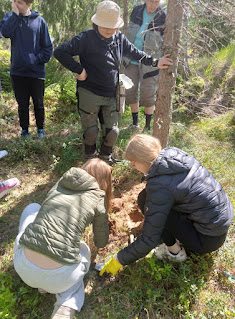
Some 15-20 people participated in this years excavation and the work progressed very well indeed. Already on day two it was possible to document the uppermost layer of the hearth. It proved to be almost round in shape and constructed of two layers of stones which were heavily firecracked . The soil inside hearth was sooty and contained many large fragments of charcoal. These will this week be sent to the Tandem Laboratory at Uppsala University for C14 dating.


The reason for the excavation in 2025 was this hearth that we stumbled upon during the last day of excavations in 2024.

The finds found in the area surrounding the hearth were extremely few due to the fact that the find layer had been almost completely "plowed away" when the area was used as a market garden. All the finds like pottery, flintartefacts and flint flakes however pointed towards the early and and especially the middle phases of the Typical Comb Ceramic Period (ca 5 800-5 500 BP).


Potsherds and flint flakes showing signs of use  from the area around the hearth.

During the last two days of the excavation we were able to make some trial excavation pits in order to plan next years fieldwork. Sadly most of the area proved to be equally demolished by ploughing and artificial levelling of the slope to build a house garden. However in area some 40 meters from this years excavation area a small piece of the site seemed to have been spared. 

Trial excavations on the 4th day of the excavation.

The finds from two of the pits in this area were especially promising. We will continue excavations here in May 2026. Register to the excavation here https://ilmonet.fi/course/V260058

Finds from the trial excavation. A large flake of blood red flint and Typical- and Late Comb Ceramic potsherds